Reading to girls

An Atlantic piece today outlines some current research that is very much in line with my own.

The researchers found a gender difference in what they call “teaching activities” that build cognitive skills in children as young as nine months old. Girls, not boys, in all three countries received more time from parents on three activities: reading, storytelling, and teaching letters and numbers. Baker and Milligan scrutinized data for first-born children, to control for differences arising when parents slack off after baby number two or three arrives. They also examined parents’ time spent with boy-girl twins and again found boys receiving less time than girls on the three teaching activities.

I’ve found a small, but statistically significant difference in the amount of time parents spend reading to girls at ages one, three, and five as part of a paper focused on relationship quality and investments in children.

They’ve got a very economist-y explanation for the behavior: “It is just more costly to provide a unit of reading to a boy than to a girl because the boy doesn’t sit still, you know, doesn’t pay attention,” Michael Baker told NPR (on his research with Kevin Milligan).

Costs are not just about money, people.

Lean In, Dad, if you can

I’m in that period of my life where my friends are starting to have babies. The wedding invitations that filled my mailbox up until last year have been replaced with baby announcements and family photos. It’s hard to believe that I have no weddings to attend this year. Like an actual zero.

I’m not sure if it’s the labor economist in me, but I ask pretty much everyone what their parental leave policy is. How much time are you taking off? How much time is your partner taking off? How much is paid, how much is unpaid? I just learned Gettysburg offers a one-course reduction for “secondary caregivers” (I must say, I do like the gender neutral language, even if it is implied that the dad is the secondary). There are all sorts of restrictions about when you can take it and how often, because I’m sure that parents are going to time their childbearing to maximize the number of classes they can get out of (no, they’re not; that’s ridiculous). Sometimes people just offer the information:

The fact remains that there isn’t a lot of support for two-parent caregiving, at least in this country. I am impressed, though, with how many of my male friends and colleagues have taken time off, even if unpaid, and have taken the time to actually caregive, as opposed to using it for personal or professional gain. 

Catherine Rampell has an op-ed in the NYT today on increasing parity among caregivers’ leave policies. She suggests that parental leave, or rather paternal leave, is an important aspect of not only equity in the workplace and ensuring that we continue to chip away at the gender pay gap, the glass ceiling, and other forms of discrimination. In addition, she suggests that mere exposure to full-time caregiving in the early stages of a child’s life might lead to more equitable distribution of household and caregiving work as the child ages. It’s actually a big deal!

This might not sound like such a big deal, but social scientists are coming around to the notion that a man spending a few weeks at home with his newborn can help recast expectations and gender roles, at work and home, for a long time. A striking new study by a Cornell graduate student, Ankita Patnaik, based on a new paid paternity-leave quota in Quebec, found that parents’ time use changed significantly. Several years after being exposed to the reform, fathers spent more time in child care and domestic work — particularly “time-inflexible” chores, like cooking, that cut into working hours — than fathers who weren’t exposed to the reform. More important, mothers spent considerably more time at work growing their careers and contributing more to the economy, all without any public mandates or shaming.

Perhaps the most amusing part of the article is that the comments section is filled with screeds against “procreators.” Yes, I get it. The planet has a lot of people on it and you’ve made a personal decision not to procreate. But, two things. One, individuals don’t make the decision to put hundreds of thousands of dollars into a child because they’re going to get two weeks off. If you think that, you need to take an economics class. And two, if you want to reduce population growth, donate to programs that work to educate children, improve access to contraception and family planning services, reduce child mortality, and give young women jobs, all of which are actually proven to reduce fertility rates.

Woohoo, Spring Break Reading List!

It’s Spring Break for Gettysburg College, which means I have jetted off to somewhere it decidedly does not look like Spring. Well, perhaps at least in the conventional definition. I’m quite happy to see snowflakes my entire break, but many of my students were appalled that I wasn’t heading south for warmer weather. Oh, well.

A break from classes means work with new data, getting caught up with student blog posts, and of course books. Below is a peek into what I’m reading this week, though it likely won’t be the last you hear from me about these books.

March 8th is really one of the best days of the year

I love March 8th. First of all, it’s my mom’s birthday. Who wouldn’t love a day that set the stage for me coming into the world. More importantly, though, it’s International Women’s Day. And though this week, it also happens to fall on the day of Hugo Chávez’s funeral, that really only serves to remind me of the last International Women’s Day I spent in Caracas.

The last week has been filled with lots of news on the ladybusiness front. The Violence Against Women Act Reauthorization (VAWA) passed both houses and was signed by the President after much too long a delay. Domestic violence is getting all kinds of attention due to the murder of a South African woman who happened to be in a relationship with a somewhat famous Olympic athlete. Vida’s annual count of women writers, book reviewers, interviews, and contributors in major magazines came out. In many cases, it’s worse than you thought. I mean, really, essentially no change over three years?

So, for this Women’s Day, I thought I would mention the names and sites of a few female journalists and academics who I think are kicking a** for women all around. Some write on “women’s issues.” Some are so-called “feminist bloggers.” Some I saw in San Diego at the meetings and am still kicking myself for not introducing myself. Next year, Betsey, next year.

Without further ado, in no particular order, a list of women writers you should be reading.

There are so many more. I think that’s enough for today! Tell a woman you know she’s amazing and deserves to live a life free from violence.

Mental labor of the always connected

Amanda Marcotte has an excellent piece out on the mental labor that falls more heavily upon women in the household. While chores may be more evenly split, women are still the ones exerting the effort to split the work, to nag when it doesn’t get done, and finally, likely to do it if really doesn’t get done.

Though perhaps unrelated to gender, the piece prompted me to think about how my workload has changed over the course of my short teaching career. In particular, I find myself spending a lot more time with my students than I did when I first started, and more time fretting about them getting their work done. This is my invisible work, keeping track of student assignments, making sure they’re on track to finish their research papers, worrying about their sick grandmothers, and more. It reminds me of my college roommate, who since we’ve aged and mellowed a bit, has reminded me several times how stressed out I made her through my procrastination while students at Duke. As the years have gone by, students seem to want more of my email time, and at all hours of the day, even as the face time has not changed much. Like many professors, I try to limit my time on email. There are many activities and conversations that can be more efficiently performed in person. For instance, if you email me asking how to calculate Adjusted R squared and ask why it’s different from R squared, I’m going to ask you to come talk to me instead of typing out those equations. I promise you’ll learn it better and it will take both of us less time.

More and more of these emails seem to come in the middle of the night, before exams, before homework assignments are due, etc. I tend not to answer those late night emails and I don’t accept them as excuses for not doing work. I have a policy about late work; It’s in the syllabus. I’m not going to remind you of it a million times either. It’s your job to keep track of your work.

I do this partly for my own sanity (avoiding mental labor at least a few hours of the day), but also because I believe that as an educator, I should be preparing my students for the real world. They need to learn to produce timely work—even if it’s not perfect—to manage their time, to realize that help is not available at all hours. That’s the real world, right?

More and more of what I hear though, is that it’s not. One serious problem that professors have is that they don’t live in the real world they’re trying to prepare students for. The only jobs I’ve worked outside of academia since 2006 have been consulting, hardly indicative of day-to-day office jobs that are commonplace for recent grads (when they’re getting jobs, that is). While some friends assure me I don’t want to be there among the unwashed masses, it’s a real liability for professors, especially if a whole new economy has popped up around being constantly available and connected and cheap, as some are claiming.

In response, some universities are advertising for positions to be just that for students: constantly available, connected, and (likely) cheap. This Western Governors University position wants a PhD economist to be available essentially 24/7 to tutor students who are struggling. I admire them being honest about the hours and expectations, but is that really the most efficient use of a PhD’s time? Answering the same email over and over again at 3am about opportunity costs? And they have similar positions open in almost every field. Is it really in students’ best interests to reinforce that work should be round-the-clock? That someone will be there to answer questions all the time?

Marissa Mayer, the CEO of Yahoo!, was recently lambasted by any number of individuals and groups for telling telecommuting employees that their flexible work schedule days are over and that employees can’t work from home anymore. While I disagree with the fundamentals of the decision for reasons that have to do with supporting working parents and caregivers, I’m sure she has internal reasons for her actions and the point about separation is important. It’s ridiculous how many of us check our email at the bar, respond to a client in the middle of dinner with another client, interrupt play time to read another message from our bosses. The WGU positions mentioned above actually erase all of those boundaries between work and home, keeping us constantly connected, constantly answering emails. There is no office, no in-real-life contact with students. It’s not teaching, but “mentoring,” and it reinforces the idea that someone should be working constantly. If you’re a student, it’s you and your professors. If you’re in the workforce, it’s you and your boss. If you’re the boss, it’s you and your employees.

College is kind of a special time. If you’re not up all night writing a paper, you’re up all night debating philosophy, or driving to the nearest Krispy Kreme, or or doing all manner of legal, illegal, silly, and serious things. There’s a reason that we don’t continue that madness (or at least some of us don’t) into our 20s and 30s, and especially not into our work.

And if work is really now 24/7, how the heck do we get it to not be? Certainly not by hiring people specifically for that purpose.

Thanks to @katinalynn for comments on a first draft of this post.

VAWA passes!

This is old news by this point, I know. I tell ya, you go to lunch and big things happen. The Violence Against Women Reauthorization bill passed the House of Representatives today in the form passed by the Senate earlier this month. Yay! And given President Obama’s comments, I think we can safely say it will be law soon. I am very disappointed to see that Scott Perry voted against it. I guess he just needs to hear from me more often.

Now, fix the sequester?


As long as we’re talking about violence against women…

It’s VAW week here, it seems. I railed about the Oscar Pistorius trial last week and how it obscures the larger pictures of violence against women in South Africa. As of last night, it seems that the House is ready to (sneakily?) pass the Senate version of the Violence Against Women Reauthorization Act, replete with protection for LGBTQ individuals and college students, and a strengthened ability for trial courts to act within their own borders (call your congressperson). The CDC also released a special report of its violence and victimization data with a focus on gender and sexual orientation. This is huge because national level surveys often don’t provide large enough samples of LGBTQ individuals or victims of violence in general to extrapolate to national level statistics.

Last, but not least, the UNFPA released a pamphlet advertising its commitment to data-gathering on violence against women and girls and gender-based violence. In the era of big data, it’s perhaps hard to believe. But while we may be able to track all of the things you buy and the time you spend driving and how much time you spend on the internet at work instead of working, we know very little about gender-based violence all over the world. In my own field work, perhaps the biggest constraint I found is that there is not a good consensus on how to define violence. UNFPA agrees:

Why is it so hard for the humanitarian community to generate quality data and meet ethical and safety standards?
• Lack of standardization in GBV terminology, data collection tools and incident classification; also, lack of uniformity in how and what data is collected.
If I have to be a brat about it, I’d say what data are collected, but I think the spirit is right. Consensus on what is included in violence and better attention paid to the dangers and pitfall associated with measuring violence against women and girls should be a significant part of the work going forward.

CDC intimate violence report by gender and sexual orientation

For what appears to the be the first time, the CDC has released a report on intimate partner violence separated out by sexual orientation. As most national level surveys that address domestic violence include very limited samples of out LGBT populations, this is pretty huge. After a quick read, the report seems to confirm what we already knew, that lesbian and bisexual women are more likely to have been stalked and experienced rape or physical violence by an intimate partner. While 35% of heterosexual women report one or more of these, 43.8% of lesbian women and 61.1% of bisexual women report the violations. Heterosexual and bisexual women reported mostly male perpetrators (98.7% and 89.5%), while lesbian women reported mostly (67.4%) female perpetrators.

Bisexual men also reported higher levels than heterosexual men of lifetime prevalence of rape, physical violence and/or stalking by an intimate partner, but gay men had the lowest rate. The numbers might surprise you. 29% of heterosexual men report such violations, while 35.0% of heterosexual women did, with the vast majority of both reporting that the offender was of the opposite sex.

It’s important to note that the takeaway message from these findings is not that men and women batter at the same rate. These statistics are well in line with survey results from national level longitudinal studies such as the National Survey on Families and Households in spirit, if not in absolute percentages (underreporting on such surveys is expected). Extensive work on surveys like this repeatedly emphasize that incidence and report of violence are not the same as power and control. While relatively similar numbers of men (~25%) and women (>30%) report light to moderate physical violence, far more women (23.6% of hetersoexual women to 29.4% of lesbian women) than men (13.9%-16.4%)report severe physical violence, including half of bisexual women.

HALF.

These statistics underscore the disproportionately large role that men play in perpetrating violence, even while it obscures the larger reasons behind it. They also show those in the LGBT community are at much greater risk for violence and stalking by intimate partner, be it a man or a woman, and hopefully calls attention to the need for the House of Representatives to pass VAWA in the form passed with a strong bipartisan majority in the Senate.

I wrote my Congressman

I’m kind of new to this Pennsylvania resident thing. Despite having taught at Gettysburg for a year and a half now, I still pay a lot of attention to Colorado politics, to Venezuelan politics, even to North Carolina politics. However, I’m also a whiz at writing to my representatives in Congress and Senators, and I figure it’s time I do that a little more regularly with the people I voted for (or didn’t vote for) in November.

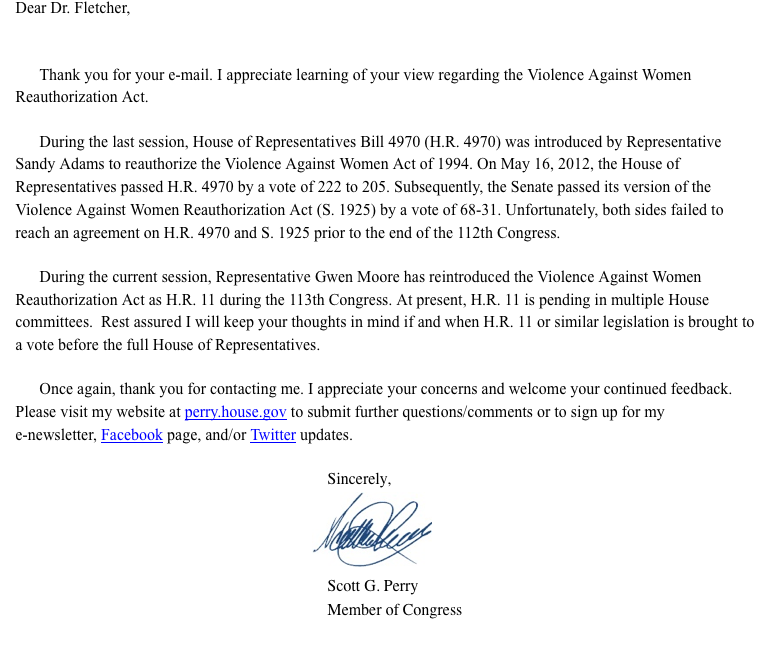
The Violence Against Women Act is a piece of legislation that’s very close to my heart, having studied it in depth as a graduate student and tried everything in my power to get an economics dissertation out of it. It didn’t fly, but you can bet Scott Perry‘s going to go get a few letters from me this week as the House version makes its way through committees. I thought I’d share his latest response to my letter urging him to pass VAWA in the form the Senate had passed it, which I was surprised to see was rather specific and didn’t commit to a position.

ScottPerryLetterI’m used to getting replies from members of Congress that say something to the effect of, “thanks for your concern and taking time to write,” but this one outlined the VAWA saga for me. It’s just a form letter, I know, (though you can bet I made sure to put the Dr. part in there) but he’s new and he doesn’t seem to have committed to a side yet. Maybe there’s hope.

Write your congressperson!

Update: As I was writing this, Roll Call published a piece saying that the House might actually vote on the Senate version as early as Thursday. Cautiously optimistic?

So many NBER papers I want to read today

Good thing I’m traveling this afternoon. (All gated, sorry.)

  1. Long-Term Neighborhood Effects on Low-Income Families: Evidence from Moving to Opportunity Abstract: We examine long-term neighborhood effects on low-income families using data from the Moving to Opportunity (MTO) randomized housing-mobility experiment, which offered some public-housing families but not others the chance to move to less-disadvantaged neighborhoods. We show that 10-15 years after baseline MTO improves adult physical and mental health; has no detectable effect on economic outcomes, youth schooling and youth physical health; and mixed results by gender on other youth outcomes, with girls doing better on some measures and boys doing worse. Despite the somewhat mixed pattern of impacts on traditional behavioral outcomes, MTO moves substantially improve adult subjective well-being.
  2. New Evidence on the Impacts of Access to and Attending Universal Childcare in Canada Abstract: In Canada, advocates of universal child care often point to policies implemented in Quebec as providing a model for early education and care policies in other provinces. While these policies have proven to be incredibly popular among citizens, initial evaluations of access to these programs indicated they led to a multitude of undesirable child developmental, health and family outcomes. These research findings ignited substantial controversy and criticism. In this study, we show the robustness of the initial analyses to i) concerns over whether negative outcomes would vanish over time as suppliers gained experience providing child care, ii) concerns regarding multiple testing, and iii) concerns that the original test measured the causal impact of childcare availability and not child care attendance. A notable exception is that despite estimated effects stemming from the policy indicating declines in motor-social development scores in Quebec relative to the rest of Canada, our analyses imply that on average attending childcare in Canada leads to a significant increase in this test score. However, our analysis reveals substantial heterogeneity in program impacts that occur in response to the Quebec policies and indicates that most of the negative impacts reported in earlier research are driven by children from families who only attended childcare in response to the implementation of this policy.
  3. Profitability of Fertilizer: Experimental Evidence from Female Rice Farmers in Mali Abstract: In an experiment providing fertilizer grants to women rice farmers in Mali, we found that women who received fertilizer increased both the quantity of fertilizer they used on their plots and complementary inputs such as herbicides and hired labor. This highlights that farmers respond to an increase in availability of one input by re-optimizing other inputs, making it challenging to isolate the returns to any one input. We also found that while the increase in inputs led to a significantly higher level of output, we find no evidence that profits increased. Our results suggest that fertilizer’s impact on profits is small compared to other sources of variation. This may make it difficult for farmers to observe the impact of fertilizer on their plots, and accordingly this affects their ability to learn about the returns to fertilizer and could affect their decision to adopt even in the absence of credit constraints.