Director of monetization: Economy 2.0?

About a year ago, a good friend of mine started developing an online gaming platform. The point was to create a place for several different game creators to host their games, increase their user base and allow for exchange of in-game currencies. We talked a lot about, and I thought even more about, how to create an in-game currency in a way that reflected use preferences, wouldn’t inflate or deflate too quickly, and ultimately, would earn my friend some real cash.

The platform is in beta now, and we never managed to formalize some of the things we’d hoped to test, but since then, we’ve exchanged lots of emails and articles about in-game economies, inflation, relative worth of found objects and more. Just last week, we had dinner and my friend asked whether I thought gaming companies employed economists to create in-game economies. Some, he contended, were incredibly realistic and well designed, others suffered from gluts of goods and all other sorts of problems. We got an answer fairly quickly. This month’s JOE (Job Openings for Economists) came out today and while flipping through it, I saw this notice, for a job at fiveoneninegames, looking rather conspicuous among the ads for financial analysts and visiting assistant professors.

The funniest part of all this, of course, is that I’ve never played one of these role-playing games. Bejeweled? Zuma’s Revenge? Sure, but I’m much more of a crossword and sudoku kind of girl. All the same, I’m really tempted to apply. Is that weird? The idea of having total control over an economy (even with a non random, selected set of participants in the game) sounds so appealing.

Okay, weird, I know. Back to running regressions.

It’s not that I do everything Justin Wolfers tells me to do…

But I did find this fun. On the Freakonomics blog today Justin Wolfers uses the 1940 census–which was just scanned and all put online–to find who was living in his house in 1940. I’ve spent quite a bit of time with other US Census records from earlier years. At one point, while taking economic history in graduate school, I found my grandfather and his parents and theirs in Georgia and North Carolina in the 1930, 1920, and 1910 records. I didn’t actually need these things for class; I was supposed to be looking for saloon-hall dancers and prostitutes in the 1860s Colorado mining towns, but that’s a blog post for another day.

I’m in the process of searching for my great grandparents in the 1940 census, as I know they moved around quite a bit after the crash, and my grandfather had already left home by 1940, but I did look at my current address in the Pennsylvania records ala Wolfers. The plaque outside my house in Gettysburg says it was built by a doctor who served in the Civil War and stuck around after it was over. By 1940, however, the house belonged to Helen Culp, a 52-year old single schoolteacher who finished college, and her sister, Margaret, a 37-year old department store employee, who finished high school. Though entirely coincidental, it feels appropriate that I should spend my time in Gettysburg in an educated, female teacher’s house. Helen and Margaret were white, their parents were born in Pennsylvania just as they were, and they grew up speaking English at home*. Helen earned $1400 in 1939 and her sister, $700. Helen’s salary is worth about $22,000 in 2010 dollars if we use Purchasing Power Parity calculations, but could have represented a lot more if we measure it by ‘prestige’ or ‘economic power’. If you haven’t used www.eh.net‘s “How Much is That” tool, you should; it’s super fun.

Helen said the value of her house was $5000. This is almost three years’ salary for her, which tells me that either she was paid very well for the time, or that houses were much cheaper in Gettysburg in 1940. I’m fairly certain I could not purchase my house with three years’ salary (although, Helen, at 52, had likely been teaching for much longer than I have). Currently, houses in Gettysburg are pretty expensive, at least compared to surrounding areas, primarily due to historical value, laws governing historical buildings and their preservation or destruction, and limits on building height and density.

This particular exercise amuses me because I’ve never actually lived in a house that was old enough to be in any of these records. Even in Boulder, CO, which is a fairly old town for the Western US, none of the places I lived was more than 40 or 50 years old. And now, I live in a house that is 145 years old. As an American from a relatively recently populated part of the country, I think all this old stuff is so interesting. It’s how I felt in Boston, too; history just seems to weigh heavier.

I only skimmed the pages before I found my address, but in looking at all the people who lived on my street and neighboring ones, I’m also struck by how little migration there is in and out of Adams County. Most people on the page lived in the same place 5 years before. If they didn’t, they came from New Oxford and Ortanna and Cashtown, towns that are within 7-10 miles of Gettysburg. This internal migration map of the US in 2011 shows that not much has changed. Like the 1940 inhabitants of my house and their neighbors, people don’t really move to, or leave Gettysburg, particularly not when compared to Boulder.

Well, except me (and college students).

*Two respondents per page were asked some supplemental questions about their parents, marriage history, and veteran status. Helen happened to be #14 on the page, so she was asked those questions as well. Some of these questions were standard on earlier Censuses, which is part of how I traced my greatgreatgrandparents back to North Carolina.
The value of financial history

Last week, when Eric Hanushek was at Gettysburg College for the Finance Symposium, we got into a post-symposium debate over a couple of glasses of wine concerning the usefulness of historians. In a place like Gettysburg, where most everyone is a historian of some stripe, this is a relevant argument. Gettysburg hosts the Civil War Institute and several scholars who study just that. Civil War buffs travel from all over the country–and perhaps even the world (are there non-American Civil War buffs?) to visit the battlefield and the town. They walk over Cemetery Ridge and Seminary Ridge and talk about Pickett’s Charge* and strategy and the people who died and go on ghost tours. Students and scholars read books and reimagine history, too. Hanushek argued that history is unlikely to change much because we already know all the facts and thus studying it, or at least writing several new books and papers on topics that had been exhausted, was perhaps not the best use of intelligent peoples’ time.

Last summer, I attended the Canadian Network of Economic Historians conference. It’s a great group of scholars who I’m sure would profoundly disagree with Eric’s argument, and they were particularly excited when I told them about my plans. “Gettysburg is going to have three economic historians!?” someone asked me. Actually, no. One retired, one is on leave–the one whom I’m replacing–and me, well, I don’t really consider myself an economic historian.

Despite that lack of self-identified association, I was ready to tell Eric he was wrong. I do have a few papers in economic history, using financial transaction and shareholding data from 18th century England. It’s really cool. Which is exactly what I told Eric. Perhaps I’m not going to entirely rewrite the History (with a capital H) of the establishment of the English stock market and modern portfolio theory, but I probably can make little changes to our understanding of how financial markets worked, how investors made decisions, and what effect that might have on commerce, trading, and the like.

In one of these papers, a coauthor and I show that despite relatively established secondary markets for trading shares of companies, individuals did not tend to buy in more than one company. Wealth constraints and the value of being able to vote likely trumped the relative ease with which one could stroll down to Garroway’s in Exchange Alley and pick up a few extra shares. In another, we show how women (who likely couldn’t stroll down to Exchange Alley for propriety reason) used the market.

Like I said, I’m not changing the history of the world, but it’s kind of cool to know that investors weren’t diversifying over these kinds of assets as we might expect modern investors to do. (Which, incidentally, they don’t always do, either).

I’ve been discussing some of these ideas with a few colleagues and all of a sudden, the ideas are flowing. Over lunch today, we mapped out at least half a dozen papers that could come out of these data. So now, my problem is this: how do I go on the market as a labor economist with a slew of papers that fall better under financial macro and economic history? I usually say that being a labor economist means I can do whatever I want, so there it is, I guess.

*Notes:

  1. The Battle of Gettysburg was July 1-3, 1863.
  2. You now know pretty much everything that I do about the Battle of Gettysburg.

And then they all went home and did their homework

This blog is about economics, and I intend to keep it that way, but I wanted to express my joy for a minute at my students getting involved. Last night, Rick Santorum, former PA Senator and GOP candidate for the presidential nomination, chose to spend the evening in my little town of Gettysburg. He set up shop in the historic Gettysburg Hotel on the square (which is only kind of historic because the hotel, built in 1767, was totally rebuilt a few decades after the war and actually burned down in 1983).

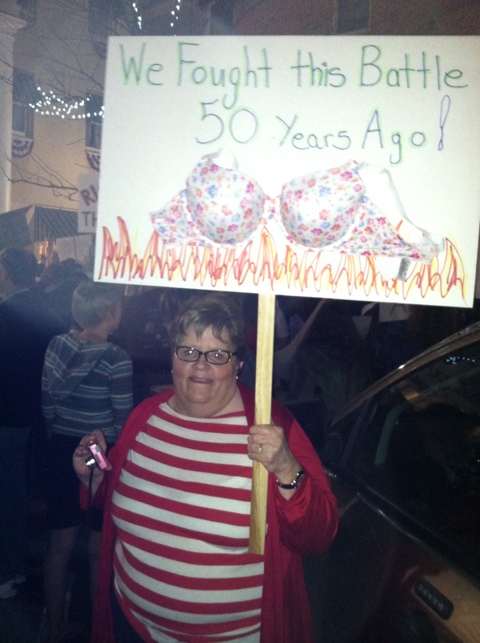
I was promised bra burning and protestors, and though I had no desire to stand in line for hours (6:45 for a proposed 8pm start would have gotten you in for the actually 9:30 speech), I was curious to see who and what turned up. Sadly, there was no bra-burning, but there were several posters with bras attached.

Otherwise, the group was surprisingly diverse. I watched several Gettysburg College students file in, mingled with older locals and families from around the area. I’m told about 750 people actually made it into the ballroom. Outside, people from Occupy Harrisburg turned out. Ron Paul supporters (this is Gettysburg people, he did go to school here) were in full chant mode. The group of older women with burning bras and signs declaring “we fought this war 50 years ago” and “Women Beware” were among my favorites.

Most heartwarming, though, was the throng of students. On the protesting side, the Gettysburg Allies group came with rainbow flags and purple shirts and a circular piece of Styrofoam with the word Bayer on it. A group of female students changed “Keep your rosaries off my ovaries” and others joined in the OWS chanting. Inside, several students got in and told me today about how exciting it was. Regardless of what they thought of him, it was exciting for them to be there with the people and the cameras and the rush.

I was told, before I came here, that Gettysburg College students were pretty apathetic. It was great to see them excited and involved and participating. And seeing that their participation was part of something larger. It’s so important. Even I was really excited. I tweeted about it constantly, and it’s not like it was a big, significant event with people getting arrested or police brutality. It was mostly a bunch of students and locals, showing that they care, one way or the other.

And then they all went home and did their homework.

20120321-111550.jpg

I’m back!

So, I didn’t entirely meet my goal of not working last week. I did take a few blissful days off in Miami. I actually did nothing. No reading for pleasure, no twitter, no blogging, no student papers. It was pretty awesome.

But it didn’t last for long. On Friday, I spent an hour talking to the Women in Economics group at CU, which brought me straight back to work. It was a great experience, though, and reminded me of how far I’ve come in the last year. Boulder was beautiful, the skiing was terrible, and here I am again, on my way back to Gettysburg, reading, writing, tweeting, and watching basketball.

Tomorrow, I’ll post my review of Matt Yglesias’ The Rent is Too Damn High. I won’t give anything away here.

Back to brevity and a break

Spring Break is this coming week! I’m super excited. I’m also going to take a real break. Which means as much as I can, no blogging, no twitter, no work. I need it. So, you might see a post or two here that is scheduled, but I promise, it’s not me. I mean, I wrote it, but awhile ago. The real me is reading on the beach or skiing or something else equally fabulous. I’ll be back on Monday, March 19, surely with some wonderful thing to marvel at or some bone to pick.

One day, I’ll have time to read again

I originally thought this paper was about survey fatigue, which even I, a vocal advocate of filling out surveys, experience a lot lately. But it’s about search fatigue, probably capitalizing on how a wealth of options results in decisions not quite reflecting optimal.

Consumer search is not only costly but also tiring. We characterize the intertemporal effects that search fatigue has on oligopoly prices, product proliferation, and the provision of consumer assistance (i.e., advice). These effects vary based on whether search is all-or-nothing or sequential in nature, whether learning takes place, and whether consumers exhibit brand loyalty. We perform welfare analysis and highlight the novel empirical implications that our analysis generates.

Maybe one day I’ll have time to read it. That and the million other papers on my list. May?

Carlin, Ian Bruce and Florian Ederer. “Search Fatigue.” NBER Working Paper No. 17895. March, 2012.

Boycotts are all around us

There has been quite a bit of talk lately about boycotts, in the academic world, in the foreign policy world, and in the consumer world.

Academics are signing on in rather large numbers to a boycott of the journal publisher Elsevier, for practices they view as stifling to creative and innovative thought, and access. The original call to boycott is here, the Chronicle article is here, and if you Google the thing, you’ll find dozens of blogs and articles talking about it. It doesn’t seem to have hit economists too hard yet, but I imagine it’s going that way.

In foreign policy, all the talk is about boycotting oil from Iran in order to ensure that they don’t get the bomb.

Finally comes the Apple boycott, rocking the consumer world. The NYT came out with a an article last week exposing exploitation of workers and unsafe working conditions in China by Apple. Combined with the conflict minerals stuff, some people are hoping to end their iAddictions. Others, of course, want to point out that the whole thing is ridiculous.

Of these, Iran is definitely the silliest. Oil is a fungible commodity. If we don’t buy it from Iran, we have to get it from someone else, say Norway. Thus, another country who formerly bought from Norway, will now buy it from Iran. Iran will sell it to someone else, perhaps at slightly higher transportation costs, but they still will sell it. (Update: Off the wire blog goes into this in a bit more detail here.)

I’m not entirely sure what to make of the Elsevier boycott. I am all for voting with my dollars, and my time, but I guess this feels big because it is inextricably linked to my profession and my sense of self. As graduate students, we are shown over and over again that the path to success is publish, publish, publish, get tenure, and be satisfied. But I can’t help but think that all of this is changing. It’s like the rug is being pulled out from underneath me. It’s not the end of the world surely, but I’m not sure what an open-access academic content world is going to look like. I’m sure that functionally, it won’t change much for most people. But for academics, it’s likely to change a lot. And that’s scary on some level, even if it’s also exciting and desirable.

I’m going to mull over my thoughts on the Apple boycott a bit more, but they certainly seem to be all around us, don’t they?

Update on Fun Wednesday Reading: I’m in the midst of Innes, Rob. “A Theory of Consumer Boycotts Under Symmetric Information and Imperfect Competition.” The Economic Journal, 116 (April) 355-381.

h/t @mflbellemare

Blogging

There was a bit of discussion last week on the internet on blogging by academics. Particularly for economists, blogging is a relatively new venture and as there is as yet little demonstrated value in the academic job market, it’s a source of debate.

When I decided to start this blog, I started from a much different place than many other economics bloggers. I was still in the midst of writing my dissertation and my advisors were fairly adamant that I not blog. One pointed me to an economics blogger who had just left her university without tenure and with plenty of speculation that her blogging had contributed to that. She also left with a book deal. Call it what you will, but they were worried that blogging would be seen as taking time from serious academic work and would hurt my own chances for tenure and promotion down the line. One even tried to give me a number. Each blog post a week over a year was equivalent to one academic paper, or something like that.

That’s such an economist way to look at things, isn’t it?

Beyond my less-than-junior status, I’ve been blogging for a really long time. Since my first stint in Venezuela in 2003, I’ve kept a personal blog that I used to keep in touch with family and friends. I started that blog to try to stay sane while working as a journalist in Caracas and to make notes for a book project on Venezuelan women. One post, that was reprinted in my former editor’s blog and the Duke economics department bulletin (Oeconophile), is here. It’s over eight years old now. As that blog became more and more personal in nature, it also began to reflect my dual need to write about economics and about my own experiences with graduate school. In my move to a real job, it seemed to make sense to separate the economics-type posts from the personal ones, to use my writing about economics to create a public persona, a space just for economics. I could use it as a tool for organizing research, planning classes, and sharing my thoughts about what was going on in the world. The old one is still active (and private), though the number of posts I write there is lower now as the total is about split between here and there.

I don’t think that blogging is for everyone. I realize that most people are not compelled to write in the way that I am. Most people don’t have the habit of sharing their daily lives and musings–regardless of the topic–with a potentially large, unknown audience. Twitter is changing that, but the format is quite different.

I fully realize that this blog might hurt my chances at tenure, if and when I come to that point. I really hope that it doesn’t, though. I hope that the tenure process expands to include digital scholarship and outreach.

Even in my limited use of this blog and Twitter, I’ve made contacts with other researchers I likely never would have found otherwise. I’m grateful for this and hope that it continues, that it expands into greater opportunities for collaboration, discussion, and more. This blog might lead to other things. It might not.

But old habits die hard, and I can’t imagine not doing it, so here I go.

A (useful) rape analogy

Another blogger reminds us of the twisted logic and overt sexism that is used to counter claims of rape. It’s a quick read, and might take your mind off other things you don’t want to read tonight.

I’ll raise my glass to World Peace Day, not to celebrate, but because sometimes all you can do in the face of hatred and famine and violence, is hope.