CCTs and Crime

The connection between poverty and crime is both well-established and notoriously difficult to distentangle. We know that high-crime areas are likely to be poorer than low-crime areas, and yet we don’t usually profess that crime causes poverty, although a certain blogger/writer team of economist and journalist is quick to remind you that crime doesn’t pay. We might expect poverty to cause crime for a number of reasons–idleness leads to thrill-seeking, social norms make stealing appear common or acceptable, families may not be able to feed their families without stealing–but separating one effect from the other is incredibly difficult.

In a careful and very well executed new paper by three economists at the PUC-Rio, crime is in fact lowered in the face of conditional cash transfers, or a directed attempt to put more money in the hands of low-income families while simultaneously requiring their kids to go school/not work during school hours. The authors exploit the expansion of the program–to pay benefits to families with older children–to causally identify the effect of additional income on crime.

The authors find that expanding the Bolsa Familia program to include 16- and 17-year olds did have a dramatic, causal effect on crime rates.

My primary question on the paper has to do with the expansion. Because the program had already been in place for some time, many families lost some income when their children turned 16 and thus were no longer eligible for benefits. Many of these same families would regain benefits with the expansion. So, did crime increase as these children aged out? Surely there’s some variation in average age and distribution of children in the program by school, so we should be able to at least speculate on whether there is something about turning 16 and 17 that makes one particularly prone to criminal behavior, or whether leaving the program leads to more behavior. Perhaps we can’t identify it the same way causally, but it’s an important dimension, I think.

The second problem I have is stylistic: a clear link to a number in a table with words such as “the program expansion lead to an average X% decrease in crime” would have helped make reading easier.

h/t: @franciscome

Cited: Laura Chioda, João MP de Mello and Rodrigo R. Soares. “Conditional Cash Transfer Programs: Bolsa Família and Crime in Urban Brazil.” PUC Working Paper No. 559.

Gender bias in the sciences

The internets have been buzzing lately with a new study that shows gender bias in the sciences. Per their results, women are less likely to be hired on as lab assistants, offered lower salaries than men, and deemed less competent. All this was in an experimental setting. There isn’t even some fancy statistical tricks that econometricians are super proud of to prove their results. The exact same resume was distributed to potential employers with a randomly selected name that was either typically male or typically female. On the same application, the mere appearance of a woman’s name led to fewer offers and much more criticism.

I haven’t read the paper yet, but it immediately brought to mind a similar experiment undertaken by economist Marianne Bertrand on race, published in 2004: Are Emily and Greg more employable than Lakisha and Jamal?, where employers were offered identical resumes with the names changed. Some got a resume with a generic sounding “white” name and others received the same resume with a name more common among the black population. Not surprisingly, Emily and Greg got higher ratings than Lakisha and Jamal. Just, unfortunately, as unsurprising as Jennifer receiving lower marks for competence, offered lower salaries and being offered the job less often than John.

2012/2013 Job market

I am a Labor Economist with interests in gender, families, and violence. I am currently in a visiting position at Gettysburg College and am on the 2012-2013 Economics Job Market. I will be attending and available for interviews at the ASSA/AEA meetings in January in San Diego, California. More information about me and my research, including current CV, can be found on my economics blog and personal website.

Inheritance and education as substitutes

The effect of inheritance laws on gender equity is a subject that remains largely understudied; most of the information we have is anecdotal or follows from intuitive reasoning. It makes sense that in places where land ownership is a significant predictor of future outcomes and job opportunities are limited, not owning land (or not inheriting it) would likely lead to worse outcomes. Given that inheritance laws tend to favor male children (and in some cases first-born male children), it stands to reason that women and girls would have the most to lose from disinheritance.

In a twist, a working paper by two Italian economists shows that inheritance actually leads to less investment in schooling, and more investment in health for male children, but not for female children. The paper relies on a policy change in Ghana which changed inheritance from a primarily matrilineal system to a more patrilineal system, leading to more male sons inheriting land from their fathers. The authors show, using a difference-in-difference strategy, that males who were subject to the new laws, and thus more likely to inherit land, eventually obtained one less year of education than boys who weren’t subject to the law. They were also healthier using a height-for-weight z scores, indicating higher investments in nutrition and health, which would be necessary for more efficient working of land.

The argument is that inheriting land/investments in health and education were close substitutes due to the social norm that fathers provided for their sons’ livelihoods. If a father could not provide for his child by giving him land, he could send him to school or set him up with an apprenticeship. Given limited resources, the parents might choose education over investments in health. With inheritance laws favoring sons of fathers, that “over-investment” in education ceases and higher investment in health follows. This is likely only an issue for parents for whom the constraints are binding–i.e., they have a limited amount of resources to spread around. The poorer a family is, the more likely they are to run up against this constraint, and thus the effect of the patrilineal inheritance laws is likely greater for the landowning poor than wealthier landowners.

For girls, the results are somewhat ambiguous, and theoretically, the outcome is difficult to predict. Whether girls are affected by disinheritance of land as a result of the changed law (through lower nutrition and higher education?), is likely closely tied to the social norms regarding providing for girl children. If the social norm is “people in this community (should or do) set up girls to provide for themselves,” as it appears to be for boys, we would likely see such changes in investments. If the social norm doesn’t reflect an obligation to girl children, then the change in inheritance laws shouldn’t have a great effect.

Source: La Ferrara, E. and A. Milazzo (2011) ‘Social Norms, Inheritance and Human Capital. Evidence from a Reform in the Matrilineal System in Ghana’. A preliminary draft.

Job switching among Baby Boomers

I’m teaching Labor Economics this Fall for the first time, which means I’m constantly in search of interesting ways to get students to think about how we study questions of why people work, why they get hired, how firms decide how much labor to hire, and more. In one of these quests this afternoon, I found a BLS report from July outlining duration and number of jobs held by later period Baby Boomers (born 1957-1964) over their lifetimes.

It’s a short, descriptive report and the numbers come from the NLSY79, which is a fantastic longitudinal study of employment and educational outcomes, families and more. What I found so interesting about the report is that it shows that baby boomers, on average, held 11.3 jobs over their working lives. That number struck me as high. Even though about half of those jobs were held before age 24 (think summer jobs, part-time jobs while in school), there’s still a lot of switching over 30-40 working years. And it runs contrary to the narrative that I’ve both heard and repeated, which says that our parents were likely to take one job and keep it throughout until they retired, while my generation (which is unclear to me–too old to be a Millenial, but feel too young to be Gen X), is more likely to have switch jobs often and have shorter tenures at each job.

Of course, we can’t really compare the lifelong numbers until my generation is much older, but I wonder how much that narrative is perception (because we have the closest experience to more volatile period of the ages of 18-24), or because we actually enjoy less job security.

What I’m reading

I’m headed to Maine this afternoon for a quick talk at Bates College and a wedding in Kennebunkport. I’ve never been to Maine, so I’m excited for the beach and seafood, among other things. I’m also excited to read some books that have been on my list for awhile and another that just came out. This is what I’m taking with me:

Behind the Beautiful Forevers: Life, death, and hope in a Mumbai undercity by Katherine Boo

Thinking, Fast and Slow by Nobel Prize Winner Daniel Kahneman

This Is How You Lose Herby Junot Diaz

It should be a good weekend!

Job listing of the month

I’m late to this as the website was down yesterday and the first two weeks of school have taken up tons of my time, but today’s telling job posting comes from Facebook.

Facebook is seeking exceptional PhD-level graduates in the quantitative social sciences for analytical roles in support of its advertising business and products. Analysts develop expertise in Big Data analysis and of Facebook’s advertising operations and products to provide recommendations fueled by detailed analysis and thoughtful modeling of future scenarios. They work cross-functionally with Product, Engineering and Business teams and help shape the future of Facebook. Ideal candidates combine intellectual curiosity and analytical abilities with strong time management and communication skills and a passion for Facebook.

See! They are trying to make money. And they think that an economist should tell them how to do it.

Menlo Park wouldn’t be so bad, right?

No manejamos este tipo de informacion or Caracas, part I

This is Part I of II, a bit of my August Caracas adventure. It’s a bit different style than perhaps other work you’ve seen here, but I hope you enjoy it. The following is cross-posted at Caracas Chronicles.

We’re not quite seated, but I’ve already launched into my well-rehearsed spiel. For perhaps the fifth time that day, I say I’m an American, an economics professor and I’m looking for data on domestic violence and gender-based violence in Venezuela. I want statistics, raw data, information about programs, confirmation that there really was no women’s shelter in the whole country, basically anything she could give me.

Milta Armas, a 40-something, curvy woman, starts telling me about how many women experience violence, but she refuses to look me in the eye. Armas keeps her hands in her lap, fingering a copy of the new domestic violence law, which I’m sure she’s going to hand to me later. The hype on legal reform, I expect, but not the details she’s ratling off, barely audible over the din of the INAMUJER lobby. I start jotting down her words and numbers, thinking this was easy. It only took me two ministries to start to get information. I just had to show up.

Then she pauses.

“These are, of course, what happens in the world, not in Venezuela. We don’t have these statistics for Venezuela.” Suddenly, I remember. “This,” I think to myself, “is why my expectations for this trip were low.”

I press her a little more. If those aren’t Venezuela statistics, what does she have? What data are even collected? What do we really know?

“Well,” she says without the slightest hint of embarrassment, “no manejamos este tipo de informacion.”

Oh brother.

It’s not just that the National Institute for Women, a program that houses a domestic abuse helpline and runs workshops for women living in slums on how to recognize and combat domestic violence in their homes and communities, doesn’t seem to have any information on the things they spend all day dealing with, it’s that the language she used was all too familiar. Her words mirrored exactly those of a representative of the Ministry for the Popular Power of Women, which is where I’d wasted the previous day. It was the same language I would hear later in the week as I talked to the National Police (CICPC) and when I tried to make an appointment with the National Defender of Women’s Rights.

No manejamos este tipo de informacion. And no one could tell me who does. My task, wasn’t just daunting, it was impossible. If there were no national statistics on domestic violence at the highest levels of government, I wasn’t sure to find much else.

In reality, of course, (and reality is always shady in Venezuela), there are statistics; it’s just a question of whether you know the right person to get a hold of them.

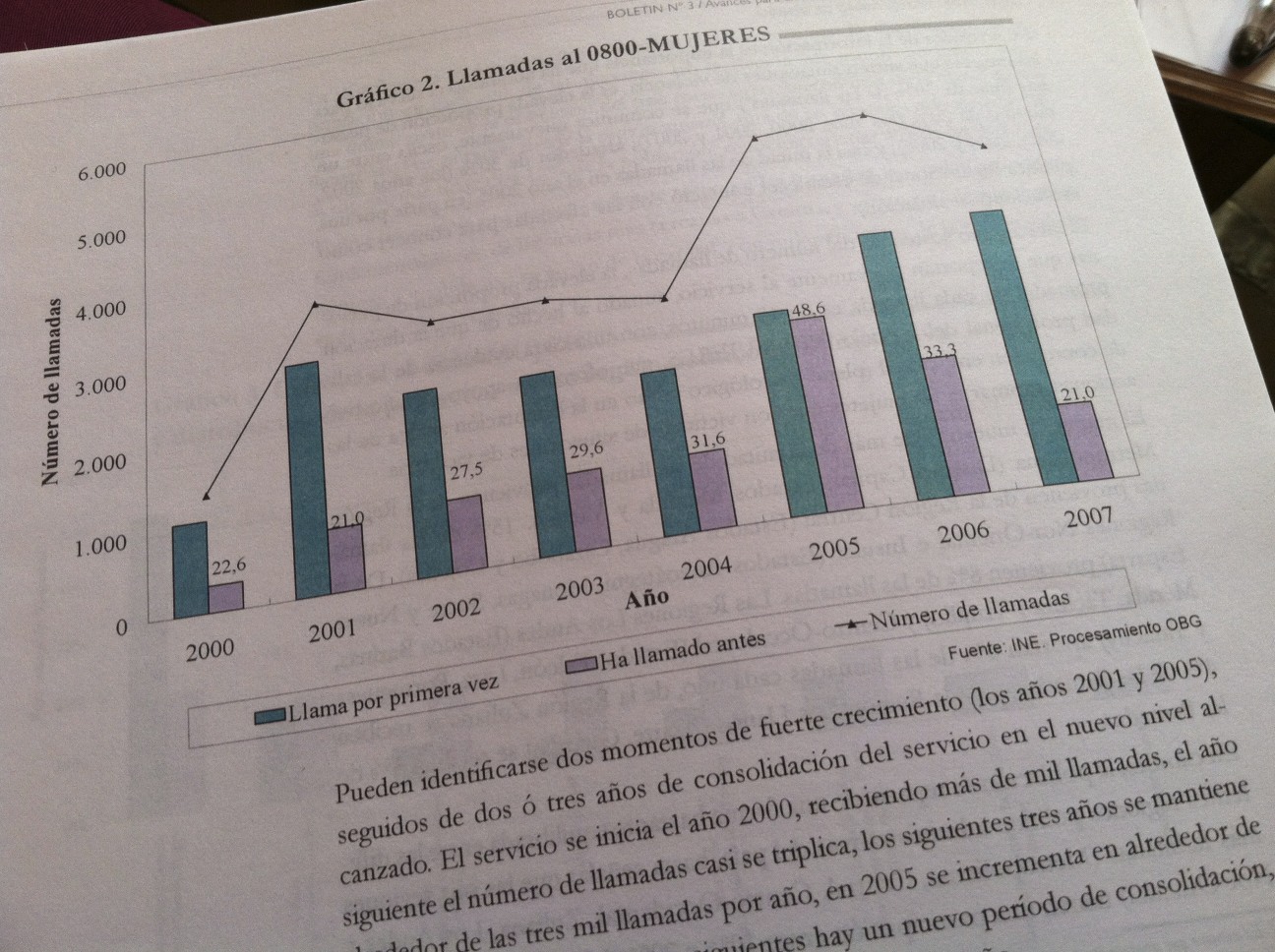
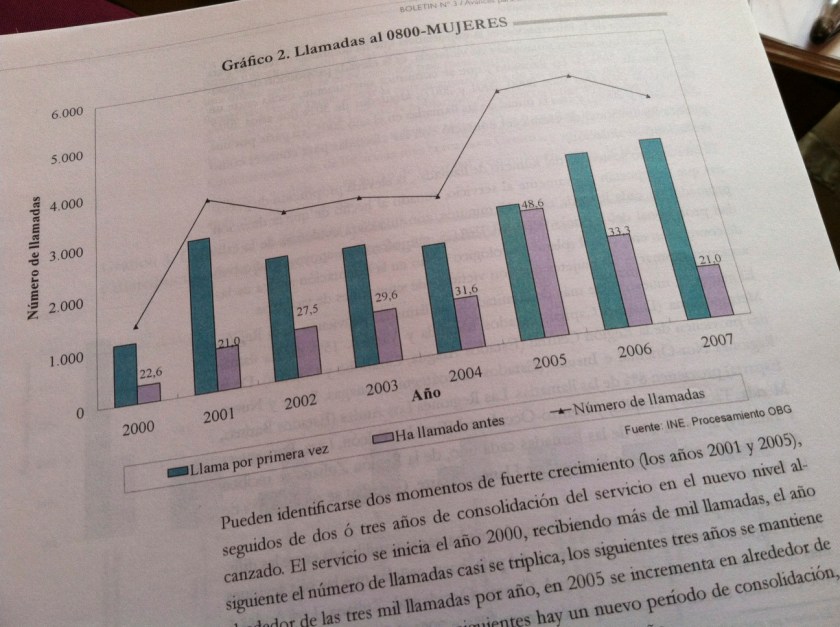
A source, who asked not to be named to make sure she keeps getting data, showed me a leaked booklet outlining statistics on the national 24/7 helpline 0-800-MUJERES, maintained and run by INAMUJER. They keep a tally of who is calling, why, what kind of abuse they are experiencing, whether they’ve called before, who the aggressor is, their mental state and more. It’s all very run-of-the-mill information that is collected on hotline calls in other places, certainly in the US. It also probably represents that best guess they have as to changes in levels of domestic violence over time, but it was not information they were willing to give to me, or even acknowledge that they had. I snuck a quick photo of a key data table – which you can see above.

I can understand why they might not trust me. Caracas’ violence problems are world-renowned and a source of embarrassment for the government and citizens; I see why they might not want a foreigner to publicize another ugly aspect of it.

Milta Armas told me that one time, there was some information, and they had put it on the website, only that as soon as they got it up, “there was an attack by the opposition to try to make the government look bad.”

“That is not a serious answer,” Ofelia Álvarez told me when I related the story. Ofelia runs Fundamujer, a nonprofit dedicated to studying and eradicating violence against women, out of her home and mostly on her own.

As one of the most visible and prominent advocates for women in Venezuela—nearly everyone I talked to sent me back to her—she has spent decades fighting the same fight I fought in just a few weeks. The issue is politically awkward: no one wants to fund studies, no one wants to support discussions. A pilot study she coauthored was abruptly defunded before it was rolled out to a representative survey group. No one handles that kind of information because there’s no desire to, she told me.

It’s not that we can’t; it’s that we don’t.

Back to School

It’s the first day of classes here at Gettysburg College and I am working hard (as I’m sure are many) to get back into the swing of things, to readjust to the humid Pennsylvania weather, and to find my rain jacket and galoshes only to have the sun come out while I’m in class.

I’m done with my first day and I’m happy to report that my students will be blogging again. This time, there will be two different classes, Quantitative Methods and Labor Economics. I’m really excited to have my Labor students reading BLS jobs reports every month and getting them as addicted to on-the-spot analysis as I am…I mean, well, moving on. Hopefully, we’ll get some good conversations going this semester.

For my part, I’ll be back up and running soon. I owe you all an explanation of what I was doing in Venezuela. It’s forthcoming and will be cross-posted at Caracas Chronicles, so might have a slightly different feel to it than what I usually write here. After that, I should be back to a normal posting schedule. My apologies for a slow August. Good luck to all going back to school with the new semester and talk to you soon!

On harmful traditional practices and disbelief

If you’ve ever read a news article about female genital mutilation or footbinding and found yourself wondering, why on earth would anyone submit another person to such a horrific act, I have just the article for you. Mackie and LeJeune, in this 2009 UNICEF working paper on harmful traditional practices, do an excellent job of explaining, without judgement and with grace, the persistence of FGM/C and footbinding (among other harmful practices) in an eloquent and approachable manner. I can’t say you’ll leave the article uplifted, but I promise it reads faster than its 42 pages might suggest. And, you’ll learn a lot. There’s even a little game theory in there for my economist friends. The abstract is here:

The essay refines the application of the social convention theory to the practice female genital mutilation/cutting (FGM/C). The theory compares footbinding in China to FGM/C in Africa, explains each practice in terms of simple game theory, and recommends that the methods used to end footbinding be adapted to end FGM/C. It hypothesizes that each practice originated in highly stratified ancient empires, and became an ongoing requirement of marriageability, general and persistent within the intramarrying community because no one family can give it up on its own. The continuation or the abandonment of each practice involves a set of social rewards and punishments and operates as what is known in social science as a social norm. The theory argues that each practice is a community practice that must be ended by the whole community coordinating on its abandonment, thereby solving the marriageability problem. The game-theoretic portrayal also identifies social dynamics of abandonment, observed in both China and Africa. An initial core group, called the critical mass, recruits others through organized diffusion, until a large enough proportion of the community, referred to as the tipping point, is ready to abandon. A moment or process of public commitment is essential to ensure a stable abandonment. The essay also refines the theory, in light of observed mass abandonments of FGM/C in different countries. Overcoming self-enforcing beliefs surrounding the practice requires credible new information, including about the feasibility and desirability of attaining the uncut alternative. FGM/C is maintained as a marriageability convention, social norm, or both. The process for reversing a social norm can be identical to reversing a social convention. Reversal is motivated by the fundamental moral norm of loving one’s children and wanting the best for them, as discovered and developed in transformative human rights deliberations. The essay establishes a conceptual foundation for programme design that facilitates community abandonment of a variety of harmful practices in ways that promote human rights and are respectful of the culture and the values of local communities.

Cited: Gerry Mackie and John LeJeune (2009), ‘Social Dynamics of Abandonment of Harmful Practices: A New Look at the Theory’. Special Series on Social Norms and Harmful Practices, Innocenti Working Paper No. 2009-06, Florence, UNICEF Innocenti Research Centre.