Spring break! Let’s read some books!

20140319-160226.jpg
Because it’s spring break and I’m furiously trying to get a paper ready for the Population Association of America meetings in May (but paper due on Monday), I haven’t been blogging so much about economics. But I feel like writing about books today, so here goes.

BuzzFeed published a listicle of strong female characters in literature we wanted to be when we were growing up. Immediately, I break into a smile because I list many of the same characters as my childhood idols, but the joy dissipates quickly as I remember that so many of those strong women characters faded from my reading list as I became a more advanced reader. A conversation with friends over dinner a few months ago resulted in each of us listing books that were important to us or had inspired us. Each of us came up with books written by women or that had strong women characters that we had read when we were younger, but as we accelerated through our childhoods and into adulthood, Blume and L’Engle turned into Steinbeck and Nabokov. Kids’ books turned into serious literature (I wish I had another font and could make a frowny face to go along with those words), and the women kind of fell off the list.

It’s not that I don’t love Steinbeck and Nabokov, I do, passionately. But I wish that I had more books from the intervening period between then and now to say, yes, that one really shaped my life or inspired me to do something in particular or put me on a path to who I was now. Although, with enough thinking, I just came up with The House of the Spirits by Isabel Allende, which in large part pushed me to study Spanish. I’ll take it, but I want more.

And I’m getting more.

One of the best parts of my decision to read only female authors in 2014 has been that everyone has a good book to recommend to me. At least among readers, most everyone I know has a book or writer that was totally unknown to me before and now makes up part of the growing list of books I want to read. My neighbor is constantly sending me texts with new books. I get random emails from friends with lists. Days after we’ve talked about it, someone will approach me with another idea. There are lots of great books by women, we’ve just somehow managed to push them down and ignore them in the face of all the other options. Some of the talk around reading women centered on this idea that focusing on it only magnified the problem. For me, focusing on the gender of the writers I’m reading and the voices I’m letting into my head has opened up this incredible fountain of books. I can’t wait to dive into the next one.

Happy Spring Break. And Happy (almost) First Day of Spring!

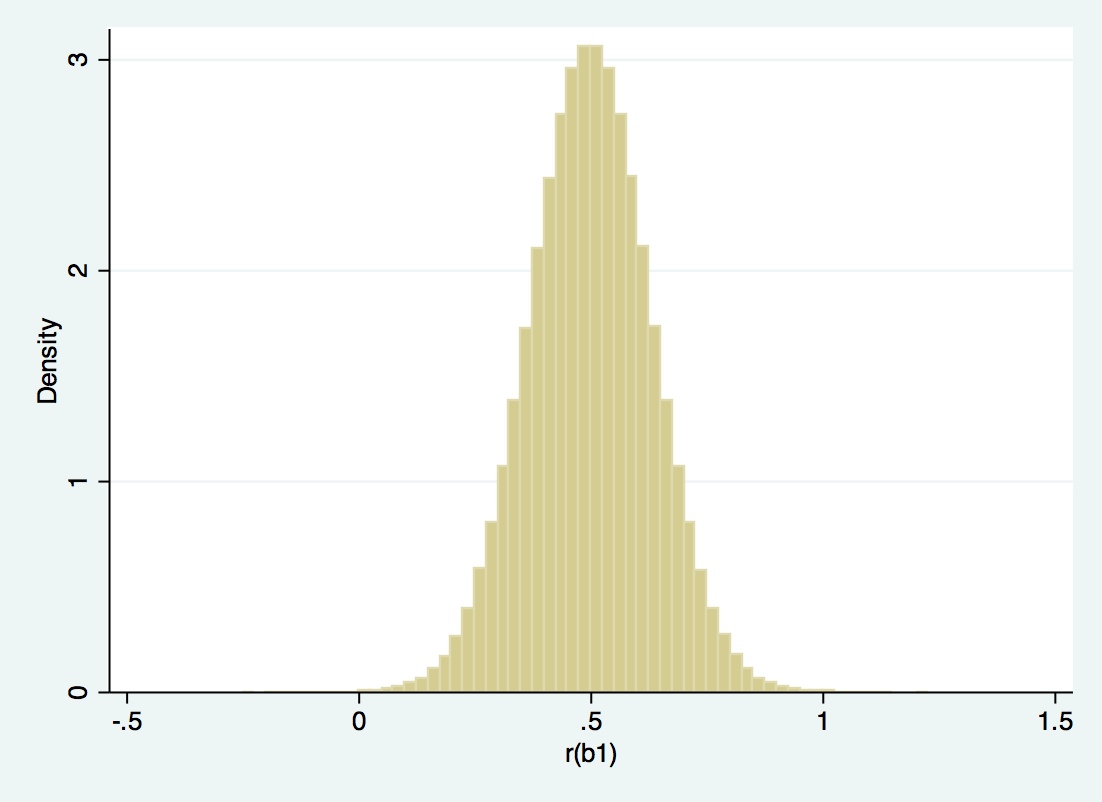
Central Limit Theorem in action

I had my #lafecon213 students run Monte Carlo simulations in class yesterday using a program we wrote in Stata. After we’d done the general one, I told them to change something about it and see how it affected the sampling distribution of the coefficient estimates. One student decided to run 100,000 repetitions of the simulation, not realizing what a time suck it would be. It took most of the rest of my lecture (surprisingly long, now that I think about it; perhaps I should complain to IT? I just tried it, pretty sure he did 1,000,000 repetitions), but when he finally had a histogram, I put it up on the big screens in my awesome smart classroom, broke into a huge grin and exclaimed, “isn’t it pretty?!”

If they didn’t think I was crazy before, they definitely do now. It took at least three minutes for them to stop laughing at me.

You have to admit it’s really pretty, no?

Monte Carlo reps output

Breastfeeding and mommy wars

Last week, a paper came out in a relatively obscure journal and got a lot of attention (or at least got its own #slatepitches headline). A sociologist at Ohio State published a study saying that the positive effects of breastfeeding essentially disappear if you look at within-sibling differences. That is to say if you compare two siblings from the same parents, one of whom was breastfed and one of whom wasn’t, there isn’t much in the way of statistically significant differences in their educational achievement, health status, or intelligence as measured by standardized tests.

In many ways, this isn’t surprising. We already know that the vast majority of our later life outcomes are determined by our parents’ incomes and education levels, where we grow up, how many words are said to us before we can even talk, and the myriad investments our parents make in our parents’ health. That breastfeeding doesn’t make a very big difference among siblings shouldn’t surprise us.

Perhaps even more important though, and this is really the kicker when trying to identify the effects of early childhood interventions, is that we don’t know what else the parents did differently for these two children. Given what we know about mothers who breastfeed—they tend to be wealthier and more educated, they get more assistance with breastfeeding education, they tend to have more flexible jobs that allow them to breastfeed for longer, or are staying at home with their kids, they’ve been told for years, etc.—we also expect them to be conscientious if they for some reason are not breastfeeding one of their children. Colen’s analysis can only control for time-invariant, mother-specific characteristics. An important omission is that she can’t control for mothers who supplement bottle-feeding with additional doctor’s visits, vitamins, extra care, more time spent together, or any other activity or characteristic that would act as a complement to breastfeeding. It ignores anything that might cancel out the fact the child isn’t getting the extra nutrients and other stuff that we ascribe to breastfeeding.

This omission is only important if it’s correlated with breastfeeding, and in all likelihood, it is. If you thought your child was missing out by not being breastfed, mothers with the ability to might try to compensate by increasing other investments.

It’s also worth noting that there are other studies using the same methodology that do find within-family effects for breastfeeding. This one, for instance, by Rees and Sabia.

Ultimately Colen wants to use the results to push for more family-friendly social policy, like increased maternity leave and more. But this is not the last word on breastfeeding. One momy blogger called it a “suspect methodology.” It’s not, it’s a perfectly valid methodology, but we need to be careful about what it’s actually showing.

Cited:

Rees, Danial and Joseph Sabia. 2009. “The Effect of Breastfeeding on Educational Attainment: Evidence from Sibling Data.” University of Colorado at Denver Working Paper 09-03.

Colen, Cynthia and DM Ramey. 2014. “Is Breast Truly Best?:Estimating the effects of breastfeeding on long-term child health in the United States using sibling comparisons.”Social Science and Medicine.

Hart, B. & Risley, T.R. “The Early Catastrophe” (2004). Education Review, 77 (1), 100-118.

Blog redesign

Things were feeling a little dated around here. I thought a redesign might get the blogging spirit running through me again. I’m not totally sold on it yet, but the times they are a-changin’.

Another seminar, another live-tweeting session

We’ve been having lots of seminars here at Lafayette this month. It’s been super fun to read my students’ tweets as they go along, so here again, I’ve storified last week’s seminar for you all, this time by Michael Clark of Trinity College. This time, we were lucky to have my colleague Chris Ruebeck tweeting alongside the students. I think he enjoyed it, too.

March job listing of the month

I probably get too much of a kick out of reading the JOE each month, but something’s gotta keep me going, right? This month’s job listing of the month comes from the American University of Nigeria. My first thought, before I read the actual ad was, “would I move to Abuja?” only to find out that the university is not in Abuja, but Yola, in Adamawa state. According to the ad: Adamawa state is “an area known as an island of peace in a sometimes troubled region.”

That sounded promising. Unfortunately for AUN, the first google result this morning for Yola says otherwise. 😦 Sorry AUN.

Google Results for Yola Nigeria this morning.

Venezuela on my mind

As many of you know, in a past life, I worked as a journalist in Venezuela (before grad school). Given everything that’s going on there right now and the uncertainty about it, I’m a little stressed out. I’m not as stressed out as, say, Francisco Toro, perhaps, but my jaw has pretty much been clenched tight for the last week.

There’s plenty of misinformation floating around as well, so I thought I would take a minute to point out the links I’ve found to be the most informative and the most useful. I wouldn’t say I’m a dispassionate observer, because I definitely have an opinion, but I think most of what is here is a good representation of the views out there in English. I certainly missed plenty of things, so if you think something else goes here, please let me know.

  • First and foremost, you should go take a look at Meridith Kohut’s slideshow in the NYT on the protests in Tachira, now widely acknowledged as the place where the protests started in response to a failure to prosecute the sexual assault of a student. The accompanying article by Willie Neuman, frankly, take it or leave it, but Meridith’s photographs are stunning.
  • Francisco Toro and the crowd at Caracas Chronicles are writing up a storm. It can be a little much at times and definitely has an opposition-leaning slant but it’s current and they have enough people/contacts all over the country to have a good idea of some of the things that are going on.
  • For a less frenetic synopsis, read Francisco’s op-ed in the NYT today. It does a great job of explaining the history of the protests, why there is likely increased aggression and repression by the government this time and more.
  • Toro’s op-ed echoes many of the themes in this piece by Rafael Uzcátegui, who writes from an anarchist-leftist perspective. Strange bedfellows, perhaps, but that’s that.
  • Don’t let the Upworthy-esque title get you down, Emiliana Duarte explains a cadena and it’s worth knowing about to understand how the government actually controls information.
  • If you understand Spanish, you should listen to Henrique Capriles Radonski’s entire speech to marchers in Caracas. If you don’t, know that he’s one of the few people calling for reason.
  • George Ciccariello-Maher explains some of the long history behind Venezuela’s protests (like back to 1989 and 1992), but mostly gives a good overview of the Maduro party line and the international left’s understanding of the situation, i.e. US and international interests pushing right-wing facism to return Venezuela to the party’s elites. Also, read anything by Eva Golinger if you’re looking for this tack in English.
  • Rebecca Hanson, a researcher living in Catia, one of the western, mostly government-sympathizing, and poorer regions of Caracas, explains where the protests aren’t happening, what that means for Venezuela.
  • “This is a marathon, not a sprint.” Francisco Toro’s AJEnglish interview on protests becoming more widespread than just the middle class, or not.

UPDATED: February 27, 2014 10:22am

Thinking about defining domestic violence

A colleague from Bates College (with whom I happened to share an advisor in grad school) visited last week to give a seminar at Lafayette and we started talking about writing a paper together. Working off each of our comparative advantages, it’s going to be about domestic violence in India.

As a result, this morning I was thinking about how to code up domestic violence to put into regression analysis and how defining gender-based or domestic violence is part and parcel to the type of question you’re trying to answer.

For example, many surveys include violence by a partner, a husband, a boyfriend, a father, an in-law, and any number of other actors. My quick response to SD this morning was to divide the categories (not mutually exclusive, perhaps) like this.

1. By a romantic partner
2. By a husband (romantic partner with legal implications)
3. By a member of her husband’s family
4. By a member of her own family.
5. By anyone when it’s gender-motivated.

2 and 3 (and possibly 1 depending on societal structures) have implications for bargaining power-type questions and investments in children. 1, 4, and 5 have greater implications for society at large.

Thoughts?

Code ’em all up, I say.

Shatanjaya Dasgupta at Lafayette College

My students live-tweeted a seminar last week at Lafayette College. I was pretty stoked on it, so I made my first Storify to commemorate it.

I’m fascinated by how my students are using twitter in the classroom this semester. We’ve had some great conversations about everything from the national debt to finance to how to use Stata. I think it will only get better as the semester goes on. You can check out the conversations at #lafecon213 and #lafecon365.

Some lighter notes for Valentine’s Day

I’ve got a nice, cynical paper post coming up, but because it’s Valentine’s Day, here are some warm and fuzzy things.

  1. The New Yorker on photographing love
  2. The US Department of the Interior’s Valentine’s Day message
  3. Things that are worse than being alone on Valentine’s Day
  4. I made you some cookies.

butter jewels