Inheritance law and suicide in India

I started to send this out as a series of tweets, but decided it was worth something a bit longer. I haven’t had much time to blog over the last 9 months, but perhaps this summer will get me writing again…

A new Anderson & Genicot paper finds that codifying inheritance rights to property for women in India lead to increased suicide rates for both men and women. The paper is based on an intrahousehold bargaining framework and rests on the mechanism whereby if women are seemingly arbitrarily given more power in relationships via more access to capital, that might cause stress and thus lead to suicide by men. It also might be that as men inherit smaller shares of their parents’ assets, it is essentially an unexpected shock and could cause financial stress that could lead to suicide. There is precedent for this interpretation in the literature, particularly in sociology.

For women, the argument to me is less clear. The inherited property, though perhaps causing additional marital discord or stress, is also 1) an increase in potential income–which should theoretically decrease overall stress levels, and 2) a better outside option, leaving women more free to leave a relationship. If either of these hold, they should actually lead to a decrease in the suicide rate.

Also, suicide rates are not just going up for married men and women. The WHO recently announced that suicide is the biggest killer of adolescent girls worldwide. Even though adolescent girls can inherit property in India (from what I can tell, there is no bar based on age of majority), they’re probably not the largest group of inheritors. So, do we believe that suicide rates for adolescent girls are totally unrelated to suicide rates for older women and men? I doubt it, especially given a large body of work that posits that suicide rates may be influenced by media coverage of suicide (for example). That suicide is driven by the inheritance law requires us to believe they are mostly unrelated. Or that girls are so stressed about the idea of one day owning and running a farm that they check out early.

While the empirical work appears to be very strong in the Anderson and Genicot paper, I’m not sold on the theoretical mechanism. Moving towards gender equality in places with strong traditional gender roles and norms is likely to put stress on many individuals. Reallocation of profits and assets will also understandably cause unexpected wealth shocks for both men and women and could lead to marital discord, but it could also lead to stronger, more independent women. Further, higher rates of suicide among groups that are likely unaffected by the law change suggest something unobserved is affecting suicide rates.

Photography, History, and Awesome Women

If y’all don’t know how much I love photographas, well, I’m telling you now, I love photographs. I haven’t written much lately about history, but I love history, too. And I really love old photographs, historical photographs, and photographs of women doing awesome things. So, for this International Women’s Day, I saved a link to some fantastic old photos of women being awesome. That’s just how we do.

Happy International Women’s Day!

#Dataviz fun

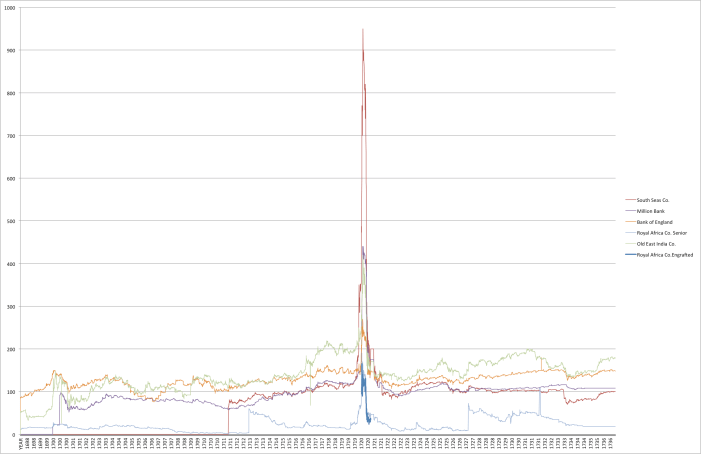
The Bank of England just released three centuries’ worth of economic data to hype up its data visualization competition. As someone who once spent a lot of time with 18th century stock market data from England, I feel a little giddy seeing it all. On that note, my paper on share portfolios in the early 18th century with Ann Carlos and Larry Neal is available on the Economic History Review Website. And my favorite #dataviz from the project (that actually didn’t quite make it into the paper) is pasted below.

Now, that’s a bubble!Share prices in Pounds 1711 to 1736

Two of my favorite things

I spent the morning relearning R, or at least one tiny bit of R. I ended up with some nice maps on female labor force participation in India.

Maps and FLFP. Two of my favorite things! 🙂

Source: NSS 68
Source: NSS 68

CSWEP Junior Economists Mentoring Breaksfasts

It’s almost that time again. The ASSAs are fast upon us and while I haven’t been quite as attuned to the job market this year, I’m surely going to attend the meetings when they are in a place I have free paid for place to stay (my apartment, that is). With that, I’d also like to call your attention to the third annual mentoring breakfasts for women put on by CSWEP. Details below. I’ll hopefully be there on Monday. Hope to see some of you there!

Also worth noting. There’s a mid-career peer mentoring breakfast on Sunday this year, too.

Spaces Available for CSWEP’s Mentoring Breakfasts for Junior Economists

Two Sessions: Saturday, January 3rd & Monday, January 5th

8:00-10:0AM, Sheraton Boston, Fairfax A& B

For more info and to register, visit: http://bit.ly/1y9v8yC

CSWEP is pleased to host the third annual mentoring breakfasts for junior economists from 8-10AM on Saturday, January 3rd & Monday, January 5th in the Sheraton Boston, Fairfax A&B.  At these informal meet and greet events, senior economists (predominately senior women) will be on hand to provide mentoring and networking opportunities.

Junior economists are invited to drop in with questions on topics such as publishing, teaching, grant writing, networking, job search, career paths, and the tenure process.  For the 2015 breakfasts we will encourage rotation of mentees so that they may have the opportunity to connect with a greater number of mentors.

Mentors are currently committed from Agnes Scott, Brown, BU, Colgate, Columbia, Duke, Federal Reserve Bank of New York, George Mason, Georgetown, Illinois, Indiana, MacArthur Foundation, Maryland, Missouri-St. Louis, Occidental, Princeton, Providence College, UCBerkeley, UCLA, UNC- Chapel Hill, University of Texas, UPenn, USM, and Virginia.

Junior economists who have completed their PhD in the past 6 years or graduate students who are on the job market are particularly encouraged to attend.  The event is open to both males and females.

Agricultural technology adoption and persistence

A new paper (gated) by Michael Carter, Rachid Laagja and Dean Yang shows, using a randomized fertilizer subsidy, that reducing costs increases adoption, but also, somewhat in opposition to previous research and importantly, that adoption is persistent into the following season.

First, we provide one of the 􏰄first randomized controlled trials of the impact of an input subsidy program, and the 􏰄first to measure impacts on a range of important household outcomes beyond fertilizer use itself. The only previous study using randomized methods is Dufl􏰅o et al. (2011), who estimate impacts of fertilizer subsidies on fertilizer use alone (in rural Kenya). We show positive impacts of input subsidies (in Mozambique) on a range of outcomes beyond input use, including farm output, household consumption, assets, and housing quality.

Second, we 􏰄find positive e􏰃ffects of input subsidies that persist up to two annual agricultural seasons beyond the season in which the subsidies were off􏰃ered. This result contrasts with Du􏰅flo et al. (2011), who 􏰄find no persistent impact of either 􏰀heavy􏰁 (50%) subsidies for fertilizer or the 􏰀well-timed nudge􏰁 of o􏰃ffering free delivery at the time of the previous harvest. Both treatments raise fertilizer use in the season they are provided, but impacts are very close to zero and not statistically signi􏰄ficantly di􏰃fferent from zero in the next season.

Having spent a lot of time lately with a friend writing a book on fertilizer and the apparent failure to launch of Africa’s Green Revolution, my thoughts immediately go to whether the fertilizer available on the market is real and how perceptions of fake fertilizer are affecting the decisions of farmers to continue (or not) using fertilizer in their fields.

Luckily, a few people are looking into this and maybe we’ll have some answers soon.

Data inanities

I feel like half the time I read something from one of these data news explainer sites, I want to blog about how silly it is. So while I’ve been wrestling with what to write here regarding a series of terrible NYT op-eds (no, I won’t link to them, but you know which ones I’m talking about), I will take a minute to call out 538 for publishing this article complaining that giving students free lunch is going to make data analysis difficult.

It’s absolutely true that students receiving free lunches is a proxy for student poverty. In fact, in my own teaching, we talk about proxy variables by examining a data set of school characteristics and students achievement scores. We actually run regressions where I encourage students to think about socioeconomic status and poverty through school lunch programs (along with other measures). But it’s also a rather coarse measure. In the way that school lunch programs have traditionally been applied, if you fail to meet some income threshold, you get free lunch, and in some cases, free breakfast. In Colorado, for a family of four, it’s $44,123. While it’s useful for looking at broad categories, it doesn’t tell you anything about the heterogeneity within those categories. The number of kids qualifying for free lunch could be the same at two different schools, but if one school is in a relatively homogenous district with most families hovering around the cutoff point and the other pulls from one very rich area and one very poor area, looking at those schools as the same actually “muddies” the waters” more than diluting the program.

So, it’s not actually a great measure, anyway, which we’ve kind of already covered by calling it a “proxy.” So why not look for better measures? The article mentions education levels of parents; that’s a good one. Or economic variables of the surrounding districts could work. Property values, for instance, are widely available and could be linked to school district. This is a little more work perhaps, because often these variables aren’t automatically linked to school quality data.

It’s true; we don’t like change. And changing a commonly used measure of poverty means looking for new answers, and that trends over time will be a bit difficult to determine for awhile, but with a little hard work and ingenuity, the new answers should be better. Decrying the end of a poor measure of socioeconomic status when its expansion will actually help a lot of kids at the margin is just not very useful. Why not spend a little more time thinking about how we can make data better, answer questions more fully, and ultimately improve school experiences for kids?

DV is (in all likelihood) not lower among NFL players

This past week, Benjamin Morris of Vox published an article claiming to show that NFL players are not nearly as violent to their significant others one might think given the rash of disheartening news lately. Using crime data, he attempts to show how arrest rates for domestic violence among NFL players are lower than his comparison group.

Morris takes arrest records from the NFL and compares them to arrest records for 24-29 year old men. This is the first problem with his analysis. He finds that the average age of an NFL player is 27-29, and so claims the relevant comparison group is 24-29 year old men, but it’s not. The average age of an NFL player may be 27-29, but there is a much wider distribution of ages among NFL players than 24-29. Severe physical domestic violence, like many types of crime, is highest among young men and drops off in older age groups. This is a well-documented phenomenon for violent crime, though I’d argue less well understood regarding domestic violence. So while there may not be many 38-year olds in the NFL, comparing them to 24-29-year olds is inherently a problem and biases him away from finding similar rates to the national average.

So why not take just the abuse by 24-29 year olds in the NFL? That likely would lead to some sample size issues, but perhaps it would be better? Not really. Even if we accept his comparison group on the basis of age, it has other issues.

That NFL players are public figures and wealthy makes them less likely to be arrested for (at least) three reasons. One is that the incentives are aligned such that victims will be less likely to call the police.* The potential for significant media attention on your private life is a huge deterrent for victims who are often hiding the abuse from even family and friends. Secondly, also regarding the incentives of the victim, the financial losses from an NFL player being suspended or expelled are huge, both in absolute terms and relative to career earnings. If you miss two games of a 40-game career, that’s significant. A financially dependent significant other also suffers if that happens, one, financially, but also in the case that the abuser elevates the abuse as a punishment for help-seeking.** Third, I’d guess that a lot of police officers are football fans and police officers in many places have discretion in whether to arrest someone. Some don’t, obviously, there are mandatory arrest laws in many places, though variably enforced, which we can talk about those some other time, but in all likelihood, some discretion. But barring any good evidence, I’d venture to guess that for a given 911 domestic violence call, your average 24-29 year old is more likely to be arrested than your average NFL player. And for your given domestic violence incident, significant others of NFL players are less likely to call 911 than your average victim. Again, biases the arrest rate of NFL players downward and away from the national average.

So maybe your comparison group should be other wealthy, public figures. Income and prestige clearly play a role here that is being ignored when you compare arrest rates in the general population to a small, elite group of athletes. Compare them to basketball players or baseball players or best yet, compare them to football players who got cut. Free research idea: check the rosters of NFL players who were cut and see how often they get arrested for domestic violence. That would probably give a better picture of what the arrest rate would look like for NFL players in the absence of the prestige and income issues. But again, you can’t really compare the groups because the income/fame issues are salient.

There’s certainly a possibility that rates of DV are actually lower, even controlling for all of these issues. I won’t deny that it’s possible that NFL players are less likely to be abusers than other young men. They are public figures, and so one might think they pay a greater cost from behaving badly, that social strictures might govern their behavior. But history tells us otherwise: Recall Ben Roethlisberger’s return to football, others speculating that Ray Rice might return as well, media outlets checking to “see how Ray was doing” after Roger Goodell imposed a suspension from the league, the legions of female (!!) fans decked out in Ray Rice gear at the next Ravens game, etc. Social costs don’t look very high to me, and up to now, when the NFL is revising its policy on DV, financial costs have been limited as well.

They also might be different somehow from other young men. Perhaps the dedication and determination needed to succeed in the NFL makes you somehow less violent. It’s one explanation for Morris’ data conclusions, though one that doesn’t hold a lot of water in my view. They could also be different in ways that make them more violent; it’s not really clear.

In any case, lower arrest rates don’t mean lower prevalence rates. Wrong comparison group, wrong metric, wrong conclusions.

And finally, reading an article about crime and domestic violence by a man who spends time in the article admitting to knowing nothing about crime statistics is just absurd. You’re a journalist. It’s your job to ask someone who does know. There are any number of experts and papers that could have helped you to do a better job, even with the bad data. You would totally fail my econometrics class.

Some extra notes:

* Victims are well aware of the possible consequences of calling the police. While some incidents are public and police involvement is unavoidable, most incidents happen in relative privacy and a victim decides whether to involve the police. Reporting rates for domestic violence are astoundingly low and many victims don’t want to involve the police. In cases where they do want to involve the police, many hope that they’ll just help him to cool off a bit; they don’t actually want action taken against him.

** Many victims are financially dependent on their abusers and calling the police might mean they are unable to provide for themselves or their children for a short time (if he’s held in jail for the day, perhaps) or a longer time (if he is incarcerated or she decides to leave). Abusers physically and emotionally control victims through any number of channels: physical violence, instilling fear if they do certain things, controlling income, preventing them from working, and more. One victim’s story I clearly remember was that how in order to go shopping, she would have to go to the store and write down the prices of everything she wanted to buy; she would have to return home where her husband would tally the prices, calculate sales tax, and give her exactly that much money for her to go back to the store and make her purchases. Her husband would check the receipts when she came home to make sure she didn’t keep any money for herself. I’ve talked to women who spent years collecting pennies from the couch and stole dimes out of their husbands’ pockets to collect enough money to leave. These examples may seem extreme, but they’re not all that uncommon. Financial dependence is a real barrier to women leaving violent relationships and calling the police.

You can imagine how this compounds when short-lived high incomes are involved. If your partner is in the NFL and your calling the cops means he misses two games of a 70-game career, that’s a lot of money, both in absolute terms and relative to his expected lifetime earnings. So, if you take away the abuser’s income, you also take away the victim’s livelihood, which means victims might be less likely to call the police when the financial stakes are higher. While the censure coming from players and the media of domestic abusers in the NFL is laudable, I worry that a new policy, one in which players receive 6-game or even longer suspensions, may actually reduce reporting for this group.
Using technology to report crimes against women

I tweeted about an ATM-style machine in India a couple weeks ago that is designed to help women to report crimes of harassment and abuse. I’ve been thinking about what the implications are and what they might mean for women and since Katina prompted me, here are a few thoughts.

Inasmuch as I can tell, reporting a crime of harassment, rape, or sexual assault in any country is a terrible experience. In India, it is particularly bad for many of the reasons listed in the article: all-male police forces with little to no knowledge or training on how to work with victims, threats by family and community members–some of whom may be part of the police force–and threat of revictimization by the police themselves. There are groups and governments trying to combat this. For instance, the police force in Gujarat is experimenting with quotas for women in the police force. Other groups implement gender sensitization training.

So, a way to circumvent that process seems pretty ideal. The added bonus of being able to speak into the machine in the case of illiteracy is also pretty awesome, provided the ATM is in a safe place. My first question, though, is what happens next. The article mentioned at least one incident where an abusive husband was being pursued by the police, but are all complaints acted upon? If they are, a woman is eventually going to have to have contact with the police and potentially face those embarrassing questions, harassment, or groping mentioned in the article. Where is the change in the police force itself that makes reporting a not-quite-as-awful experience? One that might result in outcomes that actually help a victim?

Finally, it’s not clear that interaction with the police is the best way of stemming abuse. A widely circulated piece by a British-Pakistani entrepreneur last week showed how a serial abuser was welcomed back into her community even after several individuals had alleged abuse. A prison sentence likely won’t mean he can’t get a job or eat dinner with his family. Reporting abuse often means that for a woman.

Ultimately, until there is evolution in the acceptability of domestic violence and a rejection of norms that put women’s safety last, I’m not convinced that novel methods of reporting will have a great effect on the incidence of abuse, assault, and sexual harassment or the structures that support it.

Workin’ for a livin’ in Bangladesh: Garment workers and outcomes for women

The garment industry in Bangladesh has received a lot of bad press in the last few years with the collapse of factories and threats of boycotts by workers’ rights groups. The question of whether employment in these industries is beneficial to workers, and particularly female workers, remains open. Economists tend to emphasize the effects on female empowerment (bargaining power, buying power, delayed childbearing, for instance), while rights groups enumerate the safety concerns and potential human rights abuses (long hours, low pay, no overtime pay, etc.).

While by no means offering a definitive answer the question, a new paper by Rachel Health and Mushfiq Mobarak (NBER gated or not gated) attempts to show that the economist are right. The paper shows that exposure to garment sector jobs increases age at marriage and first birth for girls and women in Bangladesh. Child marriage and early childbirth are common in Bangladesh, outcomes which expose women and girls to abuse, early mortality and morbidity, domestic violence, low educational attainment and more. If the garment industry is avoiding or delaying some of these outcomes by providing different opportunities, that’s certainly something to note.

Perhaps more importantly, the paper shows that there are significant returns to education within the garment sector. More educated employees receive higher pay and opportunities for advancement. Subsequently, knowledge of these additional returns to education may actually increase educational attainment in addition to these other desirable outcomes. There’s some concern about endogenous factory placement in the paper and how that might affect their results, but the authors do a nice job addressing it.